
Engineering
Process Design & Plant Engineering
Plan. Design. Implement.
Process Design
Develop procedures. Design processes. Prepare for implementation.
Pergande develops process engineering concepts for new production facilities, expansions, and the optimization of existing processes. These concepts are based on product, process, and operational data, as well as your requirements. This leads to the gradual development of a plant concept—from the feasibility study to the detailed process design.
From the Fundamentals to the Design
The scope of services depends on the task at hand and the stage of planning. We organize the available data, clarify outstanding requirements, and define the process in detail. Material balances, process parameters, and equipment specifications provide a coordinated foundation for the subsequent plant design.
| Category | Services | Results and Documentation |
|---|---|---|
| Planning Basis | Review and structure client requirements, assess the existing conditions, determine the planning basis, and develop requirements and specifications | Design Basis, Requirements and Specifications |
| Concept and Feasibility | Analyze processes, prepare feasibility and concept studies, and perform initial process engineering design | Evaluated solution options, initial design data, and layout and plant concepts |
| Material and Energy Balances | Prepare mass and energy balances, map material flows, and define relevant process parameters | Balances, material flow lists, and design basis |
| Major equipment | Perform process engineering design of apparatus and components during basic engineering | Equipment lists and technical specifications |
| Batch processes and product transfer | Analyzing batch sequences over time, developing vessel interconnections and vessel transfer concepts | Batch cycle time, scheduling, and transfer concepts |
| Processes and Supply | Describe process steps, determine media and consumption data, evaluate process variants | Process and procedure descriptions, consumption data, and variant comparisons |
Flow diagrams as a consistent basis for planning
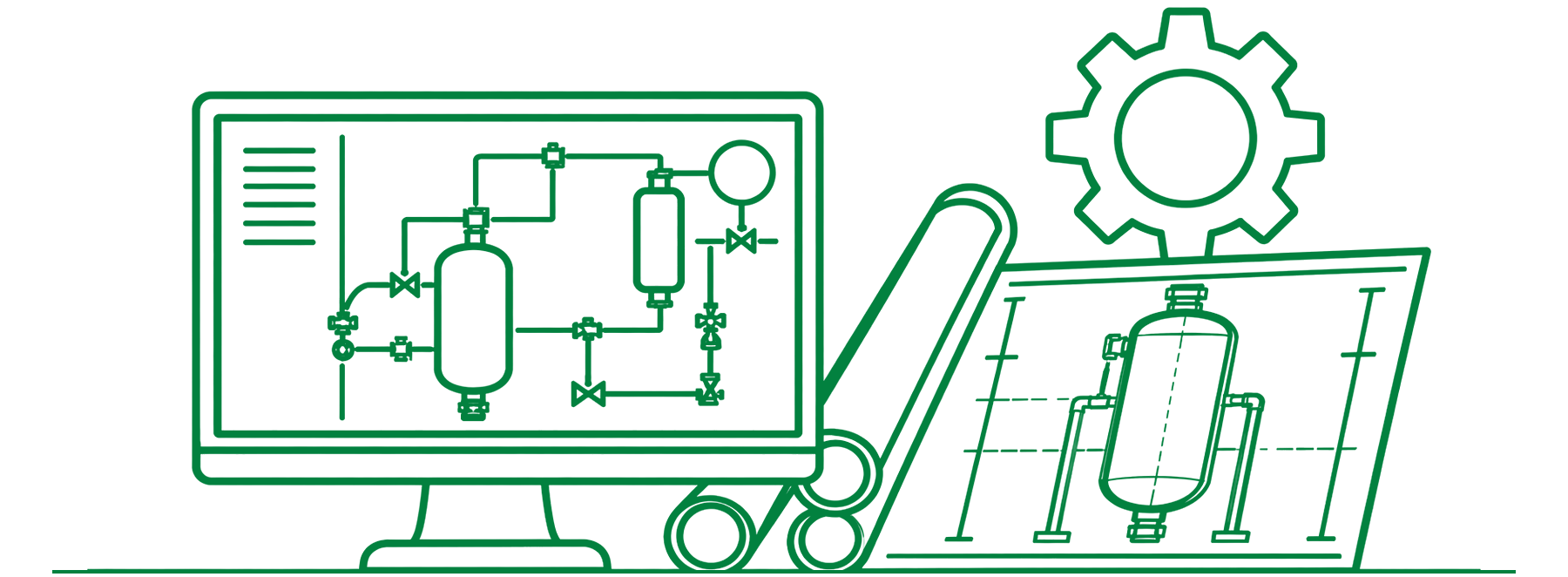
The process is first represented in block flow diagrams (BFD) showing its essential process steps. Process flow diagrams (PFD) specify the main equipment, material flows, and process data.
P&I diagrams (P&IDs) add piping, valves, and instrumentation. They form the central basis for instrumentation, plant and piping design, as well as other engineering disciplines.
Technical and Economic Evaluation
| Area | Studies | Purpose |
|---|---|---|
| Calculation and Simulation | Thermal calculations, heating and cooling processes, and CFD simulations for selected tasks | Investigating process behavior and comparing technical variants |
| Experimental Investigation | Supplementary laboratory and pilot tests at the Process Technology Center (PTC) | Validating new or complex processes through experiments |
| Safety | Project-specific safety assessments and risk evaluations | Taking requirements for industrial implementation into account at an early stage |
| Economic Feasibility | Estimate investment costs; determine or estimate operating costs as well as energy and utility requirements | Evaluate solution concepts from both technical and economic perspectives |
From Basic to Detailed Engineering
Process data, mass and energy balances, material flow lists, as well as PFDs and P&IDs are developed in detail and updated throughout the course of the project. This creates a coordinated foundation for the subsequent engineering disciplines and technical implementation.
Request a Planning Quote
Your project starts with good planning
Are you planning a new facility or an expansion of your production? Contact us—we’ll support you from concept to implementation.